
Ethan Monkhouse
Forget the endless grind of cold outreach. Getting inbound leads is all about creating such valuable content and experiences that your ideal customers find you. Instead of you chasing them, they come to you, already interested and ready to talk. This whole strategy hinges on building a rock-solid reputation and solving problems, so qualified prospects discover you organically right when they need you.
Stop Chasing: Why Inbound Is the New Default

Let's be real for a second. The old playbook of relentless cold calls and generic email blasts is dying a slow death. For high-level players like founders, VCs, and strategic advisors, your reputation is everything. Aggressive, interruptive tactics don't just feel spammy—they can actively hurt your brand.
The power has flipped. Buyers are now in the driver's seat, doing their own deep research long before they'd ever dream of talking to a salesperson. This shift is precisely why you need to master inbound leads. It's not about fluffy "branding" or creating content just for the sake of it. It’s about engineering a predictable system that brings a steady stream of warm, qualified prospects to your door—people who already get what you do and trust your expertise.
The Numbers Don't Lie
If you look at the data, the story becomes crystal clear. Over the past decade, inbound has cemented its place as the top engine for B2B lead generation. Inbound methods generate a whopping 54% more leads than old-school outbound practices. Even better, those leads cost 63% less to acquire. For any lean, high-growth operation, that economic advantage is a game-changer. These kinds of efficiencies are central to smart small business growth strategies.
This isn't just a minor improvement; the impact compounds. Companies that go all-in on an inbound motion report 2.5x higher annual revenue growth than those still stuck in the past. They also see their website conversion rates double on average, from 6% to 12%, over time.
The real goal here is to build a magnetic presence. One that pulls in high-quality deal flow while you're busy doing what you do best. Instead of grinding for every opportunity, you're creating a powerful asset that works for you 24/7.
To put it in perspective, let's break down the core differences in a side-by-side comparison.
Inbound vs Outbound: The Bottom Line
This table gives a quick snapshot of why so many are making the switch. The economic and qualitative advantages of building an inbound engine are hard to ignore.
Metric | Inbound Leads | Outbound Leads |
|---|---|---|
Cost Per Lead | ~63% lower on average. You're attracting, not buying attention. | Significantly higher due to ad spend, data lists, and labor. |
Lead Quality | High. Prospects are self-qualified and actively seeking solutions. | Low to medium. Leads are often unqualified and not in-market. |
Sales Cycle | Shorter. Leads are already educated and have established trust. | Longer. Requires extensive nurturing to build trust from scratch. |
Long-Term Asset | Creates a durable asset (content, SEO) that generates leads over time. | A temporary campaign. When you stop paying, the leads stop. |
Brand Impact | Builds authority, trust, and a positive reputation in your niche. | Can be perceived as intrusive, spammy, and damage reputation. |
Ultimately, the choice comes down to building a sustainable, long-term growth asset versus paying for short-term, interruptive attention.
From Interruption to Attraction
The fundamental difference between outbound and inbound is the approach. Outbound marketing interrupts someone's day, forcing its way in. Inbound marketing earns their attention by being genuinely helpful.
Here's the breakdown:
Outbound: This is all about pushing a generic message out to a wide net. Think cold calls, mass email blasts, and display ads that follow you around the internet.
Inbound: This is about pulling in a specific, targeted audience with genuinely useful content. Think SEO, insightful thought leadership, and exclusive reports they actually want.
This shift is more than just a change in tactics; it’s a complete strategic realignment. When you solve problems and share your expertise openly, you build a reputation that speaks for you. By the time a prospect reaches out, they aren't a cold lead. They're a warm introduction, already convinced you have the answers they need. To really nail this transition, it's worth reviewing these 8 B2B Lead Generation Best Practices.
First Things First: Who Are You Actually Trying to Reach?
Look, creating content without knowing exactly who you're talking to is like trying to hit a bullseye in the dark. It’s a surefire way to burn through your budget and end up with a bunch of articles that nobody reads. So, before you even think about writing, you have to get laser-focused on the person you want to attract. This is the bedrock of a solid inbound lead strategy.
Forget those generic, fluffy personas that get made once and then collect dust in a shared drive. We're building a tactical Ideal Lead Profile (ILP). This isn't just a thought exercise; it's your strategic blueprint. It will dictate every piece of content you create, every channel you post on, and every call-to-action you write.
Go Deeper Than Just Demographics
Too many people stop at surface-level details like job titles, company size, and industry. That’s a start, but it doesn't get you to the good stuff. To create content that truly grabs someone's attention, you have to understand what keeps them up at night.
Let's get specific. Here are a couple of ILPs that have real teeth:
"The Scale-Up Founder": She’s running a B2B SaaS company that’s doing between $1M-$10M in ARR. Her pain isn't just "growth." It's the crushing pressure to nail the right metrics to lock in her Series A funding. She's stressed about hiring the right VPs and terrified of losing market share to a competitor who just raised a massive round.
"The PE Principal": He’s an associate at a mid-market private equity firm. His biggest fear? Missing out on a game-changing acquisition. He spends his days digging for proprietary deal flow and any unique market insight that can give his firm an edge.
See the difference? We went from a generic job title to a real person with specific goals, anxieties, and motivations. This is the level of detail you need.
Map Out Their Digital Hangouts
Once you know who they are, you need to find out where they are. High-level decision-makers aren't just scrolling through their LinkedIn feed all day. They have very specific, curated places where they get their information.
You need to figure out:
Newsletters: Which industry newsletters are they actually reading every morning? Is it a big one like Term Sheet, or a niche Substack that only insiders know about?
Podcasts: What's playing in their earbuds during their commute or at the gym? Is it a major show like Acquired, or a super-specific podcast for their vertical?
Communities: Where do they go to ask for advice from people they actually trust? It might be a private Slack group, an exclusive founder community, or a high-ticket mastermind.
Getting these answers gives you a distribution roadmap. Amazing content is great, but it's useless if the right people never see it.
An ILP isn't a static document. Think of it as a living, breathing profile of the person you want as a client. It should tell you their biggest professional fears, where they turn for trusted advice, and what kind of proof they need to see before they'll even consider taking a meeting with you.
For a more structured way to tackle this, check out our guide on how to create buyer personas. It’ll walk you through building a tool you can actually use, not just a theoretical profile.
This example from Wikipedia shows a pretty standard buyer persona template.
This is a decent starting point, but your ILP needs to go a step further. You need to map out the specific trust signals and information channels that matter to senior-level operators.
Figure Out What Makes Them Trust You
Finally, what makes these people listen to one person over another? High-value leads are smart, skeptical, and don't have time to waste. They're constantly scanning for signals of real credibility before they'll give you their attention.
These trust signals often look like this:
Proprietary Data: Can you share unique data or research they can't get anywhere else?
Provocative Insights: Do you have a sharp, contrarian take on a popular trend that proves you think differently?
Hard Evidence of Results: Have you got case studies that prove you've solved their exact problem for a company just like theirs?
When you nail this foundational step, every piece of content you create will be engineered to attract and convert the exact people who can move the needle for your business. With a sharp ILP, you stop just creating content and start creating real opportunities.
Create High-Signal Content That Closes Deals

Alright, you’ve nailed down your Ideal Lead Profile. Now for the fun part: creating content that actually gets their attention. Generic, surface-level blog posts are just adding to the noise. If you want to pull in serious inbound leads, you have to produce high-signal content—stuff so insightful it immediately puts you on the map as an authority.
This isn’t about just getting clicks. It's about building trust and sparking action. The entire point is to make your expertise so valuable that your ideal leads start seeing you as their go-to resource, not just another name on a list. It’s the difference between being a commodity and becoming a category of one.
Develop Signal-Driven Thought Leadership
Let’s be honest: most "thought leadership" is just rehashing what everyone else is saying. Real thought leadership means adding a unique, valuable, and sometimes even controversial perspective to the conversation. It’s about ditching the generic "how-to" articles for a sharp point of view on a topic that matters right now.
For instance, a VC firm could write "5 Tips for Fundraising," and it would get lost in the sea of sameness. A much more powerful angle? "Why Most Pitch Decks Fail Before the Second Slide." That title immediately signals an insider's perspective and addresses a massive pain point for founders.
So, how do you find these killer angles? You have to become a student of your market.
Watch for industry shifts: Keep a close eye on new trends, regulations, or tech that’s shaking things up for your ideal leads.
Listen to your network: The best ideas almost always come from real conversations. What questions are your clients, peers, and prospects asking over and over again?
Analyze what competitors are doing (and not doing): Look for the gaps. What aren't they talking about? Where can you go deeper or offer a more nuanced take?
This approach makes sure your content isn't just relevant—it's adding real intellectual value to the discussion. That's exactly what high-level decision-makers are looking for.
Create High-Value Gated Assets
While thought leadership builds your brand, gated assets are what capture the lead. These are the meaty resources that people are actually willing to trade their contact info for. The trick is to make the value exchange feel like a total steal for them.
A generic "free guide" just won't cut it anymore. Your gated asset needs to be something they can't just find with a quick Google search.
Here's my rule of thumb for a great gated asset: create something you could confidently charge money for, and then give it away for free. That’s how you earn the right to someone's inbox.
Think about these powerful formats:
Proprietary Data Reports: Have access to unique data? Package it into an annual report. A consulting firm, for example, could publish a "State of M&A in the SaaS Sector" report.
Actionable Playbooks: Get out of the clouds and give people a step-by-step framework. A fractional CMO could create a "Go-to-Market Launch Playbook for Series A Startups."
Exclusive Tools & Templates: Build something practical—a calculator, a checklist, or a financial model that solves a real, recurring problem for your audience.
These assets are effective because they deliver immediate, tangible value. They help someone solve a problem on the spot, building a foundation of trust long before a sales call ever happens.
Backing It All Up with Data
This whole push toward high-signal content isn't just a gut feeling; the numbers back it up. Inbound lead generation has evolved into a sophisticated, data-driven game. Content marketing is 3x more efficient at generating leads than old-school outbound methods, and it now drives 51.5% of all lead acquisition.
The highest-quality leads are coming from SEO (35%) and referrals (30%), both of which are supercharged by strong, visible thought leadership. This shift is happening for a reason. Decision-makers are actively looking for experts who can help them cut through the complexity, and your content is the best tool you have to prove you’re that expert. If you want to get into the nitty-gritty of execution, it’s worth reviewing some core content marketing best practices to turn these ideas into a real lead engine.
By pairing sharp, signal-driven thought leadership with truly valuable gated assets, you create a powerful one-two punch. The first builds your reputation and pulls in an audience, and the second converts that audience into tangible leads you can nurture into clients. This is how you stop chasing opportunities and start engineering them.
Get Your Content in Front of Decision-Makers
Look, creating fantastic content is a great start, but it’s only half the job. I’ve seen so many brilliant inbound strategies fall flat for one simple reason: the right people never saw the content. This is where a smart distribution plan comes in. It’s the difference between shouting into an empty room and having a quiet, valuable conversation with your ideal lead.
We're not chasing likes and shares here. The goal is laser-focused distribution aimed at one thing: getting your expertise in front of the specific founders, investors, and partners you actually want to work with. Think quality over quantity.
This means using platforms like LinkedIn for targeted visibility, not just viral fluff. It’s about being so consistently present in the right places that when a decision-maker has a problem you can solve, you’re the first person they think of.
Go Beyond the LinkedIn Feed
LinkedIn is a powerhouse, no doubt. But if it's your only distribution channel, you're making a huge mistake. The most valuable conversations I've seen happen in more private, curated spaces. Your ideal leads are smart; they hang out in niche channels where they can get real insights without all the noise.
Your mission is to find and become a valued member of these digital watering holes.
Industry Newsletters: A single mention in a niche newsletter that your target audience actually reads is worth more than a thousand social media likes. It’s a direct, trusted line into their inbox.
Private Communities: Think Slack groups for SaaS founders or exclusive masterminds for VCs. These are the places where real problems are discussed and real advice is shared. Don’t just jump in and start pitching; become a genuinely helpful member who provides value first.
Industry Podcasts: Getting booked on a podcast your ideal leads listen to on their commute is an incredibly powerful way to build authority. You're literally in their ear, sharing what you know for 30-45 minutes straight.
This targeted approach is the heart of a solid multi-channel marketing strategy built for high-value B2B. It ensures you're not just visible, but visible to the people who sign the checks.
The Art of Repurposing
You don't need to be a content machine churning out a hundred different ideas a month. All you need is one great, high-signal insight that you can slice and dice into a dozen different formats. This is how you dominate multiple channels without burning out.
Let's say you wrote a deep-dive blog post or published a report with some proprietary data. Here's how you can atomize it:
The Pillar Post: Start with the original 2,000-word article on your site.
The LinkedIn Carousel: Pull out the key takeaways and turn them into a slick 8-10 slide visual post.
The X (Twitter) Thread: Convert the main arguments into a punchy, 12-part thread that’s easy to read and share.
The Podcast Outline: Use the article's structure as a cheat sheet for talking points when you're a guest on a show.
The Newsletter Bite: Share one compelling stat or quote from the piece with your email list, with a link back to the full article.
This isn’t about creating more work; it’s about making your best work, work harder. You’re simply translating your ideas for different platforms and how people consume content on them.
The goal isn't just to post everywhere. It's to create an echo chamber of your expertise across the specific channels where your ideal leads spend their time. When they see your name and insights in multiple trusted places, your authority skyrockets.
Let the Data Guide Your Distribution
For decision-makers whose income is tied to their reputation, the best inbound leads come from a mix of search, social proof, and nurtured relationships. The numbers don't lie.
SEO-driven inbound leads have a 14.6% close rate, which completely blows away the 1.7% from outbound efforts. At the same time, 89% of B2B marketers are on LinkedIn for lead generation, with 62% saying it generates leads twice as effectively as any other social platform. For founders and advisors, this is a wake-up call: your visible expertise on these channels is one of your most powerful and measurable tools for attracting inbound interest. You can find more stats on the impact of these channels on seoprofy.com.
This all points to a two-pronged attack. Create content that ranks on search engines for the long haul while actively sharing and discussing it on the social platforms your peers use every day. One builds lasting authority, the other creates immediate opportunities. When you get both right, your inbound engine becomes unstoppable.
Build Your Lead Capture and Nurture System
Getting attention with great content is a fantastic start, but let's be real: an inbound lead is just a name in your CRM until they're actually ready to talk. This is where you build the plumbing—the system that turns a curious click into a real sales opportunity. It's all about creating simple, obvious ways for people to raise their hand and then nurturing that initial interest with automated, valuable follow-ups.
This doesn't have to be some overly complicated, Rube Goldberg-esque machine. It starts with smart, well-placed lead capture points on your website and social profiles. Think of them as the on-ramps to your world. A lead might download a gated report from your blog, sign up for your newsletter from a link in your LinkedIn bio, or register for a webinar. The trick is to make the value exchange crystal clear and dead simple.
The whole process, from that first spark of an idea to getting it in front of the right people, is a flywheel.
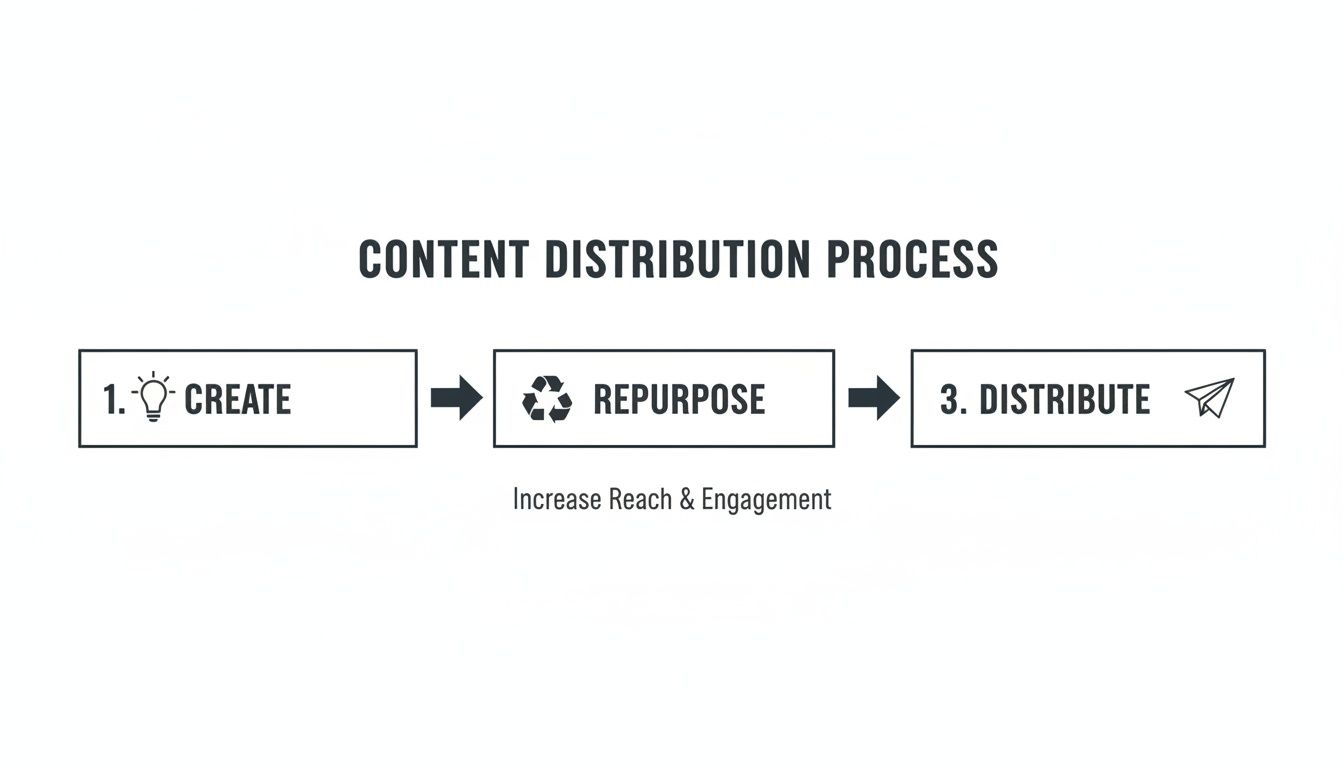
This just reinforces a point I've learned the hard way: the stuff you create to attract leads has to be chopped up, remixed, and distributed everywhere your ideal customers hang out. Otherwise, it just collects dust.
The Art of the Nurture Sequence
Here’s a tough pill to swallow: most people who download your stuff are not ready to buy. Not even close. In fact, many high-value B2B buyers do 77% of their research on their own before they ever want to talk to a salesperson. Your job isn't to pounce; it's to earn their trust over time. This is where a well-crafted nurture sequence becomes your secret weapon.
A nurture sequence is just an automated series of emails designed to build a relationship, offer more value, and keep you on their radar. It is not a sales pitch. It's a slow drip of your expertise that proves you get their world.
The whole point of a nurture sequence is to be a helpful guide, not a nagging salesperson. You want to be there with the right insight at the right moment, so when they are ready to make a move, you’re the only person they think of calling.
For example, say a VC principal downloads your report on "Q3 SaaS Valuation Trends." The last thing you should do is follow up with "Want a demo?" Instead, the sequence should build on the very topic they showed interest in:
Email 1 (Day 2): Send a link to a quick video where you break down the most surprising chart from that report.
Email 2 (Day 7): Share a link to a killer LinkedIn post you wrote about a related topic, like the rise of founder-friendly term sheets.
Email 3 (Day 20): Send over a quick case study of how you helped a portfolio company navigate a tricky valuation during a down round.
See the difference? This approach proves your expertise isn't just a one-off gimmick. It shows you live and breathe this stuff.
A Sample Nurture Cadence for High-Value Leads
Building an effective nurture system is really just about mapping out your touchpoints. You don't need a 50-email sequence. A handful of genuinely helpful interactions, spaced out properly, will do the trick.
Here’s a practical look at what a 60-day sequence might look like after someone downloads one of your gated assets. I’ve used variations of this for years.
Essential Inbound Lead Nurturing Touchpoints
Day | Action | Content/Goal |
|---|---|---|
Day 1 | Immediate Follow-Up | Deliver the asset they asked for. No funny business. Set the stage for more value to come. |
Day 5 | Value-Add Email 1 | Share a related, ungated piece of content, like a blog post or a popular video. Easy win. |
Day 15 | Social Proof Email | Send a short-and-sweet case study or even just a powerful client quote. Build trust. |
Day 30 | "Check-In" Email | Offer a genuinely interesting insight from a recent industry article or event. Show you're on the pulse. |
Day 45 | Soft CTA Email | Invite them to something low-commitment, like an upcoming webinar or a live Q&A session. |
Day 60 | Direct CTA Email | Gently ask if they're running into any of the challenges you've been talking about. Time to see if they're ready. |
This kind of structure respects their inbox and consistently proves you're a valuable resource, not a pest. By the time you finally make a direct ask, you've earned the right to.
Ultimately, this system ensures that when your ideal leads are finally ready to talk, you’re the one they call.
Measure What Matters to Scale Your Growth
We’ve all heard it: you can't improve what you don't measure. In the inbound world, it’s so easy to get caught up chasing vanity metrics like social media likes and shares. They feel good, but they don't tell you if you're actually making money.
If you want to build a growth engine that’s truly repeatable, you have to get serious about tracking the key performance indicators (KPIs) that tie directly back to revenue. This is the secret to turning your content from a simple blog post into a compounding asset for the business.
Moving Beyond Surface-Level Metrics
The real story of your inbound funnel isn't told by website traffic. It's hidden in a handful of critical numbers that reveal how efficient you are, the quality of your leads, and how much your content actually influences deals.
Here are the core KPIs I always keep on my dashboard:
Lead-to-Opportunity Rate: This is a big one. What percentage of the people filling out your forms are actually qualified enough to become a real sales opportunity? If this number is low, your content might be attracting the wrong crowd.
Customer Acquisition Cost (CAC): How much does it cost, on average, to land a new customer through your inbound machine? This is the ultimate test of your efficiency.
Content-Influenced Pipeline: Which specific articles, reports, or webinars did your best customers read or watch before signing on the dotted line? This tells you exactly what content is helping your sales team close deals.
The whole point is to create a tight feedback loop. Let the data tell you which content topics to double down on, which distribution channels to invest more in, and how to tweak your follow-up, all based on what’s actually bringing in high-value customers.
This data-first mindset is what transforms random acts of marketing into a predictable system. To go even deeper on this, check out our full guide on how to measure marketing campaign success.
When you start focusing on these business-centric KPIs, you stop guessing and start making strategic decisions. You'll know exactly which levers to pull to grow, ensuring every single piece of content you create contributes directly to the bottom line.
Got Questions? We've Got Answers
Switching gears to an inbound model always sparks a few questions. It's a big move. Here are some of the most common ones I hear from founders and the VCs who back them, along with some straight-shooting answers.
How Long Until I Actually See Inbound Leads?
Let's be real: this isn't an overnight thing. You'll probably see some early encouraging signs—more people checking out your LinkedIn profile, a bump in engagement—within a few weeks. But a steady, predictable flow of good leads? That typically takes 3-6 months of consistent work.
Think of it like building an asset, not just running a campaign. The goal is to create a library of killer, high-signal content that keeps pulling in qualified people for months, or even years, down the road. It’s a compounding game.
Can This Work if I Don't Have a Blog?
One hundred percent. A blog is just one possible channel. Honestly, for a lot of the sharp operators I work with, the best-performing "content" isn't a 2,000-word article at all. It's more direct and fits naturally into the platforms they use every day.
We're talking about things like:
Sharp, insightful commentary on LinkedIn that gets a real conversation going.
Tactical threads on X that unpack a complex strategy step-by-step.
Jumping on a niche podcast that you know for a fact your ideal customers listen to.
Sharing proprietary data or a unique framework exclusively through your newsletter.
The whole game is about sharing what you know on the channels where your target audience already hangs out.
The biggest mistake I see? People get so focused on creating the perfect piece of content that they completely forget about distribution. They'll write a masterpiece that almost no one ever sees. A winning inbound system is always 50% creation and 50% distribution.
Another classic blunder is inconsistency. Inbound rewards a steady drumbeat, not a flash in the pan. If you have more questions, especially about automated solutions, you can find more answers on their FAQ page.
Stop being paralyzed by the "Content Trap." Naviro is the first Relevance Intelligence Engine that automates the heavy lifting of thought leadership, helping you maintain a dominant market presence in just 15 minutes a week. Learn more at https://naviro.ai.


